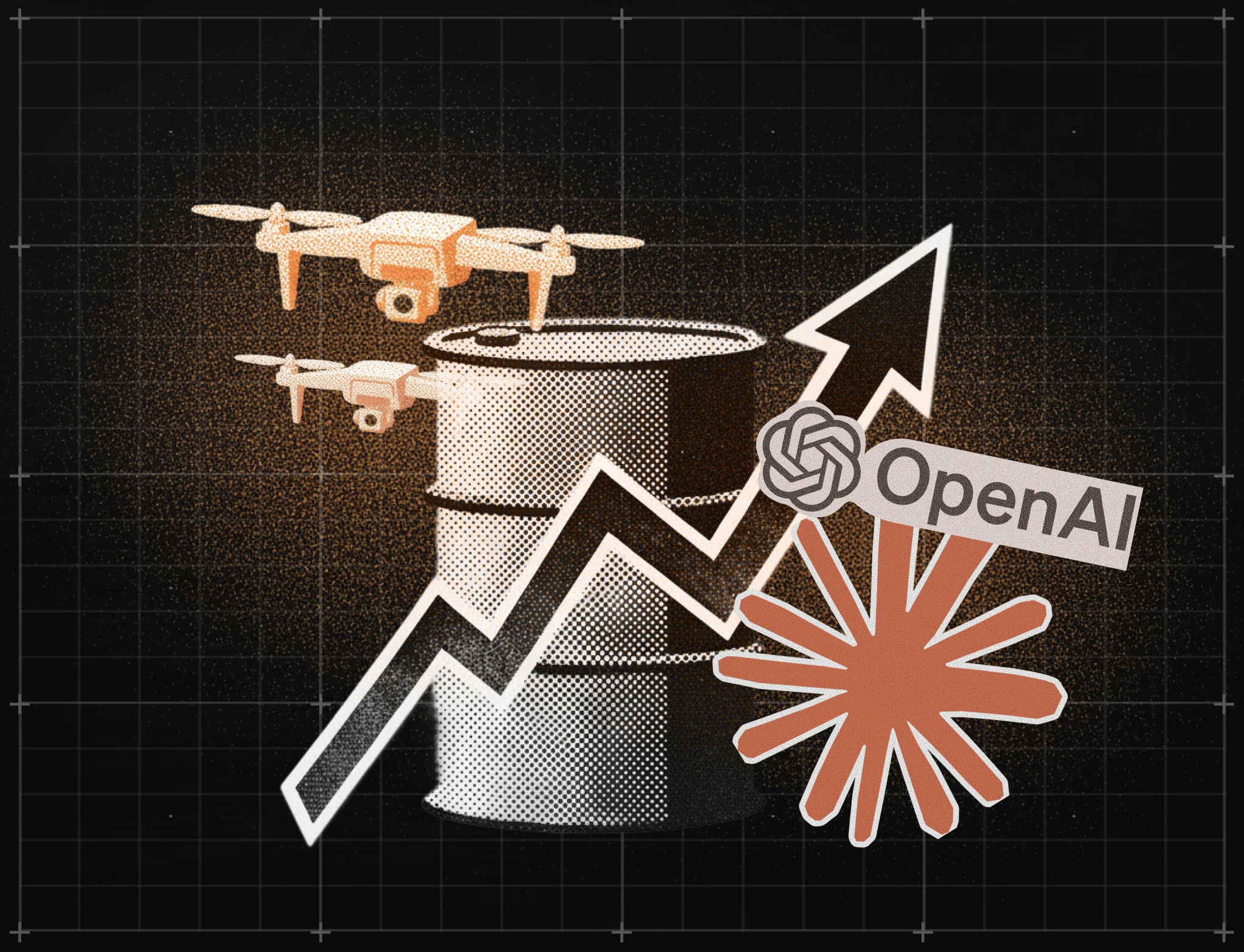
Inside the assignation of Khamenei, Nightmare oil prices (but relax hopefully), Crime actually doesn’t pay, A school thats actually harder to get into that Harvard and how Chinese EV’s are much cheaper.

Greetings folks and a warm welcome to the 20TH Edition of Friday Finance, I took liberties with the weeklyish concept, its been almost a year and a half since I posted. What a week. We started it watching a billionaire’s son outbid Netflix for Warner Bros, and ended it watching the United States and Israel attempt regime change in Iran while oil posted its biggest weekly gain since futures trading began in 1983. In between, payrolls came in at negative 92,000 (that’s not a typo), a leaked spreadsheet revealed that Mexican cartel foot soldiers earn less than government interns, a Rhodium Group report proved Chinese EV dominance has almost nothing to do with subsidies, and Rolex opened a school in Dallas with an acceptance rate rivalling Harvard’s. That might be the longest sentence in history. Lets get right to it.

Inside the assignation of Khamenei, Nightmare oil prices (but relax hopefully), Crime actually doesn’t pay, A school thats actually harder to get into that Harvard and how Chinese EV’s are much cheaper.
TL;DR:
The FT’s account of how Israel tracked Khamenei reads less like journalism and more like a very expensive spy novel. Israeli intelligence had hacked nearly every traffic camera in Tehran for years, encrypting feeds back to servers in Israel where algorithms built dossiers on bodyguards, drivers, routes, and shift schedules. They could disrupt individual mobile phone towers near Khamenei’s compound to block incoming warnings. Unit 8200 handled the signals intelligence, Mossad ran the human assets, and military intelligence digested it all into daily targeting briefs. As one Israeli official put it: “We knew Tehran like we know Jerusalem.” The tactical directive was as Israeli as it gets: if the decision maker decides someone has to be assassinated, the culture is simply to provide the targeting intelligence.
The CIA provided the final confirmation, a human source who verified Khamenei had entered the building. Israeli jets, airborne for hours to arrive on schedule, dropped approximately 30 precision munitions. The operation was part of a joint campaign codenamed “Operation Roaring Lion” by Israel and “Epic Fury” by the Pentagon, hitting 500 military targets across western and central Iran using roughly 200 fighter jets (the largest combat sortie in Israeli Air Force history). Khamenei, 86, had two bunkers but wasn’t in either. A former Mossad official invoked the Hebrew proverb “with the food comes the appetite”, the string of intelligence coups from the Nasrallah assassination to the Hezbollah pager operation had made the previously unthinkable seem merely ambitious.
The conflict has widened exactly as fast as anyone feared. From a Canadian perspective, Prime Minister Mark Carney expressed support for the strikes while denying direct Canadian involvement, though retired Major-General Denis Thompson, citing CENTCOM sources, claims Canadian forces provided intelligence support. That’s a conversation that’s going to get louder. No big deal right?
Trump said Friday there’s no deal without “unconditional surrender.” Iran’s foreign minister says they’re not seeking negotiations. Whether this produces stability or a decade of chaos is a question nobody can answer yet. I mean it worked fine in Iraq, Afghanistan, Syria and Libya right?
Sentiment
Reddit’s r/worldnews and r/geopolitics are predictably split, some see a necessary decapitation strike, others see the opening salvo of a regional war with no exit strategy. The War Zone ran detailed technical analysis of the strike package and air defence suppression. Seeking Alpha analysts are bullish on defence names across the board. The general mood: awe at the capability, anxiety about the consequences.
| Friday spot: 1 USD = 1.3652 CAD |
TL;DR:
Energy analysts have modelled this scenario for years and always hoped it would stay theoretical: Iran attacking its oil-rich neighbours while simultaneously blockading the Strait of Hormuz. Through the Strait flows a third of global seaborne crude and a fifth of the world’s LNG, about 14 million barrels per day of crude and 4 million of refined products. On March 2nd, only four tankers crossed versus a daily average of 52 in February. The IRGC declared the strait closed. Iranian missiles hit Saudi Arabia’s largest refinery, a Qatar LNG complex, a Kuwait refinery, and the Fujairah oil zone in the UAE. Qatar’s Ras Laffan, 17% of global LNG exports has been shut and QatarEnergy issued force majeure. JPMorgan estimates Iraq and Kuwait have about three and fourteen days respectively before hitting storage limits and shutting in nearly 5 million barrels per day. The Kuwaiti oil minister warned Friday that oil could double to $150 if this continues.
The insurance market tells the story in miniature. War-risk premiums have jumped from about 0.25% to as high as 3% of a ship’s value, a 12-fold increase. At least seven tankers have been struck. Trump announced the US Development Finance Corporation would provide insurance and guarantees for “all” maritime trade through the Gulf, but London brokers are unimpressed. One specialist broker said they’d heard nothing beyond the Truth Social statement. Another shipping investor noted the DFC’s main role is facilitating private investment in poorer countries, not backstopping oil tanker insurance. That being said, the IMF’s rule of thumb is that every 10% increase in oil prices reduces annual global GDP growth by about 0.15 percentage points and raises inflation by 0.4 points. At current levels, that’s already a material stagflationary shock, and Friday’s payrolls print of negative 92,000 jobs suggests the “stag” part is arriving ahead of schedule.
For context, markets have historically been surprisingly resilient through wars. Ben Carlson at A Wealth of Common Sense compiled the data: during both World Wars combined, the Dow was up 115%. Through Korea, up 60%. Through Vietnam, up 43%. After 9/11, stocks recouped losses within two months. The pattern is consistent, panic-selling into geopolitical crises has generally been the wrong move. This time is the same (the Hormuz chokepoint makes this structurally different), but it does suggest the initial reaction is often the worst of it. My electric car that I’ve been trying to sell for the last 2 years is looking like a great investment right now.
Sentiment
The Economist characterised this as the “nightmare scenario.” Atlantic Council published a measured take arguing the immediate shock is manageable but duration is the variable. Reddit’s r/investing is debating whether to panic-buy energy stocks or sit tight. War on the Rocks ran analysis on the operational tempo. The dominant mood: nervous, but not panicked — yet.
| Friday spot: 1 USD = 1.3652 CAD | Brent ~$87/bbl (~C$119/bbl) | WTI ~$90/bbl (~C$123/bbl) |
TL;DR:
When we imagine cartel economics, we tend to picture mountains of cash, gold-plated firearms, and Pablo Escobar’s hippos. The reality, according to a payroll spreadsheet recovered after the February killing of a top boss, is considerably more depressing. The average cartel foot soldier earns roughly $400 a month. To put that in perspective, Mexico’s government-funded internship programme, a centrepiece of President Claudia Sheinbaum’s strategy to address “root causes” of cartel recruitment, actually pays more.
JPMorgan notes that less than half of Mexicans are fully formally employed. Goldman Sachs flags that Mexico’s growth is heavily dependent on Washington, which is keen to see progress against drug trafficking ahead of the review of the USMCA trade agreement this July. That being said, if you’re a cartel CFO looking at that spreadsheet, the labour economics are actually brilliant: you’re paying below-market wages for work that carries existential risk, and you still have no trouble filling positions.
The leaked spreadsheet is also just a wonderful artifact of late-stage organised crime. Somewhere, a cartel accountant was diligently maintaining a payroll spreadsheet with employee names, roles, and monthly pay—presumably in Excel, presumably with conditional formatting. I wonder how they treat source deductions for income tax?
Sentiment
The Mexican Political Economist’s original analysis went viral on X, with the chart comparing cartel wages to formal sector pay drawing widespread commentary. Reddit’s r/economics found the data grimly fascinating. General mood: this says more about Mexico’s structural economic problems than it does about cartel budgets.
| Friday spot: 1 USD = 1.3652 CAD | 1 USD = ~20.5 MXN | $400 USD/month = ~C$546/month |
TL;DR:
Open up a Rolex and you’ll find a Y-shaped piece of metal so small it requires magnification to see. This is the pallet fork. Eight times every second, it seizes and releases the teeth of the escape wheel. If it fails, your $30,000 Rolex becomes a paperweight. And therein lies the problem: America has fewer than 2,000 watchmakers capable of servicing a luxury timepiece, and the demand for their skills is surging. A historic stock market run minted a new class of very rich people, the pandemic briefly turned off other ways to spend money, and Rolex now sells over a million watches a year for the first time in its history.
The school received over 560 applications for 27 spots in 2024, putting its acceptance rate at about 4.8%, Harvard territory. Students range from 18-year-olds fresh out of high school to a 48-year-old former Bosch power tool repairman. Tuition is free. Rolex pays a stipend. The curriculum starts with eight weeks of micro-mechanics (shaving brass and aluminum to tolerances of one-tenth of a millimetre), before students ever touch a watch. Adjustments are made in hundredths of a millimetre, and an imperfection of 50 micrometers on a hairspring (the size of a paint pigment) can throw off a watch by 30 seconds a day. When the GQ writer asked instructors how they identify future talent, the answer included “curiosity, patience, and whether they played with Legos as a child.” Also: “You got to be weird.”
What makes this compelling beyond luxury is the counter-disposability argument. We live in an era where fixing anything feels like an act of resistance, just buy new shoes, a new toaster, a new car. But a Rolex isn’t something you replace. It’s an heirloom, an asset, a marker of a moment. The school exists because Rolex decided the people who fix their watches are as important as the watches themselves. Plus we’ll need working Rolex’s to exchange for gasoline if the prices keep going up.
Sentiment
The GQ piece generated significant engagement on LinkedIn and X, particularly among luxury enthusiasts and trades-advocacy communities. Reddit’s r/watches was predictably delighted. The Warhammer detail — that the instructors are selecting for people who can lose themselves in intricate, repetitive tasks — resonated widely. General mood: warm, aspirational, and slightly envious
| Friday spot: 1 USD = 1.3652 CAD | $30,000 USD (entry Rolex) = ~C$40,956 | $96,000 USD/yr (grad salary) = ~C$131,059 |
TL;DR:
If you’ve spent any time in the trade policy discourse, you’ve heard the line: Chinese EVs are cheaper because of subsidies. It’s a clean narrative, politically convenient, and according to a Rhodium Group report, mostly wrong. Start with the sticker price: BYD slashed the Seal’s price from $30,198 to $24,190 between 2022 and 2024. The Tesla Model 3, despite being manufactured in Shanghai since 2019, barely budged, dropping a measly $221 in the same period. That's roughly an $8,700 retail price gap, but not all of it comes from cost. Rhodium found BYD's per-vehicle production cost advantage over Tesla is approximately $4,700, of which subsidies account for just 5% of the gap. The remaining ~$4,000 of the sticker price gap reflects BYD's willingness to accept thinner margins. In other words, BYD is both cheaper to build and chooses to charge even less.
The report also highlights extended supplier payment terms, BYD pays suppliers later than Western peers, providing a cost advantage of roughly $214 per vehicle. Not glamorous, but effective. Rhodium’s conclusion is blunt: closing the cost gap would require Western automakers to invest more deeply in China, cutting costs and jobs at home, putting them directly at odds with their own governments’ industrial policies. BYD has now officially overtaken Tesla as the world’s largest EV seller, with 2.26 million battery-electric vehicles versus Tesla’s 1.64 million. BYD even outsold Tesla in Europe for the first time last month.
The broader lesson is that industrial competitiveness isn’t just about subsidies, it’s about supply chain depth, R&D talent pipelines, and the willingness to vertically integrate. Slapping tariffs on the result is treating the symptom, not the disease.
The stock market still tells a different story, BYDDY trades around $12.66 while Tesla sits at ~$406, reflecting the market’s continued premium on Musk’s robotaxi and AI ambitions over BYD’s automotive fundamentals. Tesla has now posted two consecutive years of declining deliveries, but the market prices in a future that doesn’t involve selling cars. Whether that future materialises is another question entirely. Why did the Tesla robot break up with its girlfriend? She said he never listened. He said he was just in "Autopilot mode."
Sentiment
Reddit’s r/electricvehicles and r/investing are broadly receptive to the Rhodium data, with many noting the “subsidies explain everything” narrative was always too simple. Seeking Alpha analysts remain split on BYD’s investability given regulatory risk. The Canadian auto sector press is watching closely given USMCA implications.
| Friday spot: 1 USD = 1.3652 CAD | BYD Seal $24,190 USD = ~C$33,027 | Tesla Model 3 $32,909 USD = ~C$44,935 | Price gap: ~$8,700 USD = ~C$11,877 |
I hope you enjoyed this edition and please give me feedback on the 3 new sections that have been introduced this week: TL;DR, Market Snapshot and Sentiment. Trying to spice things up a little.
“In war, truth is the first casualty.” - Aeschylus (who, if he were alive today, would probably add that money is the second.”)
Many thanks,
Sam.
Sources
Financial Times, The Economist, GQ, Semafor, The Mexican Political Economist, Rest of World, Rhodium Group, A Wealth of Common Sense, Wall Street Journal, NPR, CNN, CNBC, Al Jazeera, Washington Post, Bloomberg, Guardian, Reuters, Atlantic Council, The War Zone, War on the Rocks, IISS, Wikipedia, Motley Fool, Seeking Alpha, Yahoo Finance, JPMorgan, Goldman Sachs, Barclays, ING, Wood Mackenzie, Morningstar, Argus Media, Spark Commodities, Platts, Argus, Vortexa, Bank of Canada, Trading Economics.