Operation Hormuz Shield
The US is thinking about taking over the Strait of Hormuz. A thought experiment on what it would cost, what it would look like, and why a better option exists.
President Trump has stated he is "thinking about taking over" the Strait of Hormuz. On March 23 he postponed a 48-hour ultimatum to Iran to reopen the strait or face strikes on its power plants, citing "productive talks" with Tehran. Iran denied any talks had occurred. The IRGC has stated the strait "may not return to its pre-war status." Tanker traffic through the world's most important energy chokepoint has fallen from roughly 100 transits per week to approximately seven. The question this report asks is not whether the US can project force into this geography. It plainly can. The question is what it would take to stay.

This analysis models three options for guaranteeing freedom of navigation through the Strait of Hormuz: a permanent DMZ requiring seizure and holding of Iranian coastline, a convoy escort system, and a counter-blockade in the Gulf of Oman. It includes full force structure modelling, cost derivations, a Korea DMZ comparison, and a full appendix with transparent math. The complete 30-page report with 82 sources is available as a PDF.
The Geography Problem
The Strait of Hormuz is approximately 167 km long and narrows to just 39 km at its tightest point. The navigable shipping channel is absurdly constrained: two lanes of roughly 3.2 km each, separated by a 3.2 km buffer, totalling approximately 11 km of usable water. This channel sits entirely within range of Iranian coastal weapons.
A proposed DMZ would require seizing and holding approximately 200 to 250 km of Iran's southern coastline, from Bandar Lengeh in the west to east of Bandar Abbas, plus five Iranian-controlled islands: Qeshm, Hormuz, Larak, Hengam, and Abu Musa. Qeshm alone is the largest island in the Persian Gulf at roughly 1,500 square kilometres. Bandar Abbas is the headquarters of the Iranian Navy.
For reference, the Korean DMZ is 250 km long and 4 km wide. A Hormuz DMZ would be comparable in length but operating in far more hostile terrain with an active maritime dimension Korea lacks entirely.
Iran's Five-Layer Kill Zone
The premise of the DMZ is that controlling the coastline neutralises the threat. It does not. Iran's anti-access/area-denial architecture operates in five layers, and a coastal buffer zone addresses at best one and a half of them.
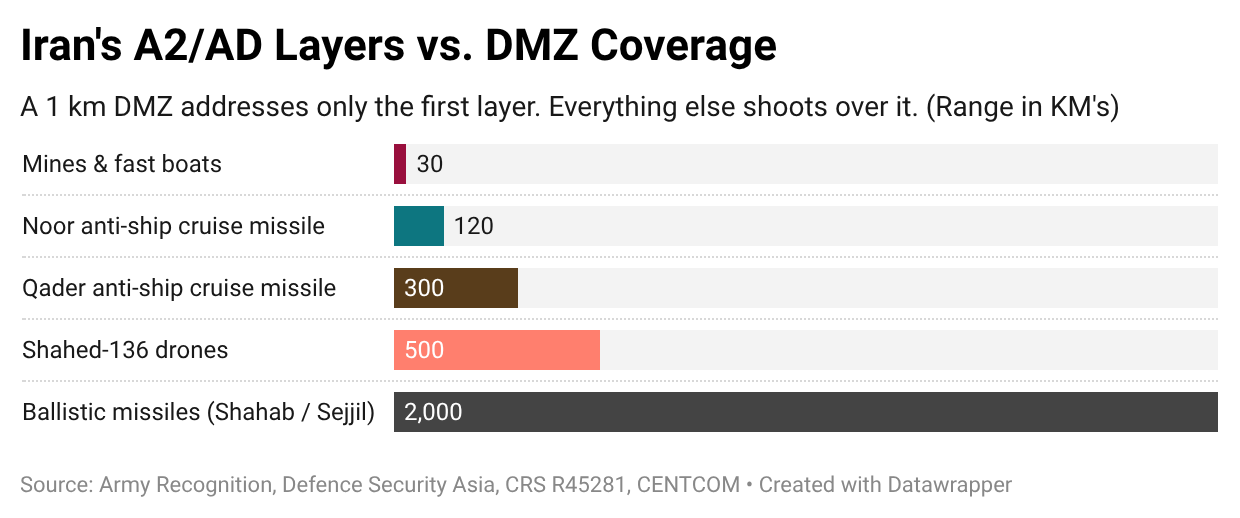
Naval mines are Iran's most asymmetric weapon. A contact mine costs as little as $1,500. Even a handful of confirmed mines can halt all commercial traffic through insurance market psychology. Iran has a stockpile of 5,000 to 6,000 mines and can re-seed the strait in hours using civilian-looking dhows. The DMZ does not address this at all. Mines are in the water, not on the coast.
Anti-ship cruise missiles are the second layer. The Noor reaches 120 km. The Qader reaches 300 km, launched from mobile truck-mounted launchers that operate 50 to 100 km inland, well beyond any buffer zone. A 1 km DMZ, or even a 15 km one, does not bring these within reach.
Ballistic missiles complete the picture at 2,000+ km range. There is no "safe rear area" within the entire Persian Gulf region.
What You Would Need to Take It
Establishing a DMZ across the Strait of Hormuz is a two-phase military problem. The first phase is the invasion: seizing Iran's southern coastline and the five islands that control the strait. The second is the garrison: holding what you took, permanently, against an adversary that never agreed to stop fighting.
Iran's northern shore is mountainous, arid, and riddled with hardened bunkers, tunnel networks, and mobile missile launcher positions carved into the Zagros foothills over 40+ years. The IRGC controls three strategically positioned islands (Qeshm, Larak, Abu Musa) which sit directly alongside the shipping lanes and function as forward operating bases packed with radar, drones, coastal missiles, and fast-attack boat pens.
Phase 1: The Invasion
The assault requires roughly 35,000 troops from a combined amphibious and airborne force. The core is a Marine Expeditionary Brigade (7,000 to 9,000 Marines) for the beach and port seizures, an Army airborne brigade (4,000 to 5,000) for inland objectives and blocking positions, three to four Army brigade combat teams (12,000 to 16,000) for the main coastal advance, and 3,000 to 4,000 special operations forces for island seizure, tunnel clearance, and targeting.
At sea, the force requires approximately 60 vessels: two carrier strike groups (the Lincoln is already in the Arabian Sea), an amphibious ready group with three to four ships, 8 to 12 mine countermeasure vessels (the most critical and scarcest asset), 10 to 15 surface combatants for air defence and shore bombardment, and logistics and hospital ships. In the air: 200 to 300 fixed-wing aircraft plus rotary-wing from both carrier decks and land-based assets in the Gulf states (to the extent basing is available). CSIS estimated Operation Epic Fury's first 100 hours at $3.7 billion, running roughly $900 million per day during active combat. The full invasion phase costs $130 to $220 billion.
Phase 2: The Garrison
Once you hold the coastline, you need to keep it. The steady-state garrison requires approximately 28,500 troops on permanent 9-to-12-month rotational deployments, similar to the Korea USFK model. This includes two Army brigade combat teams (8,000 to 10,000) for the coastal defence mission, a rotating Marine battalion (1,200) for Qeshm and the island chain, 6,000 to 8,000 support and logistics personnel, 2,000 to 3,000 for air defence (Patriot and THAAD batteries), 1,500 to 2,000 intelligence and electronic warfare, and 800 to 1,200 combat engineers for mine countermeasures and base hardening.
The naval component drops to roughly 25 permanent vessels but remains demanding: a rotating carrier strike group presence, 6 to 8 mine countermeasure vessels on continuous patrol (clearing and re-clearing the same shipping lanes), 4 to 6 patrol combatants for fast-boat interdiction, and submarine presence. The base infrastructure requirement is enormous: hardened shelters for aircraft and personnel, airstrip construction or rehabilitation, ammunition storage, water desalination plants, field hospitals, and port facilities, all built on captured territory under periodic missile and drone attack.
What It Would Actually Cost
The invasion phase costs $130 to $220 billion. The garrison settles into a steady-state of $30 to $50 billion per year, broken down across eight cost categories.
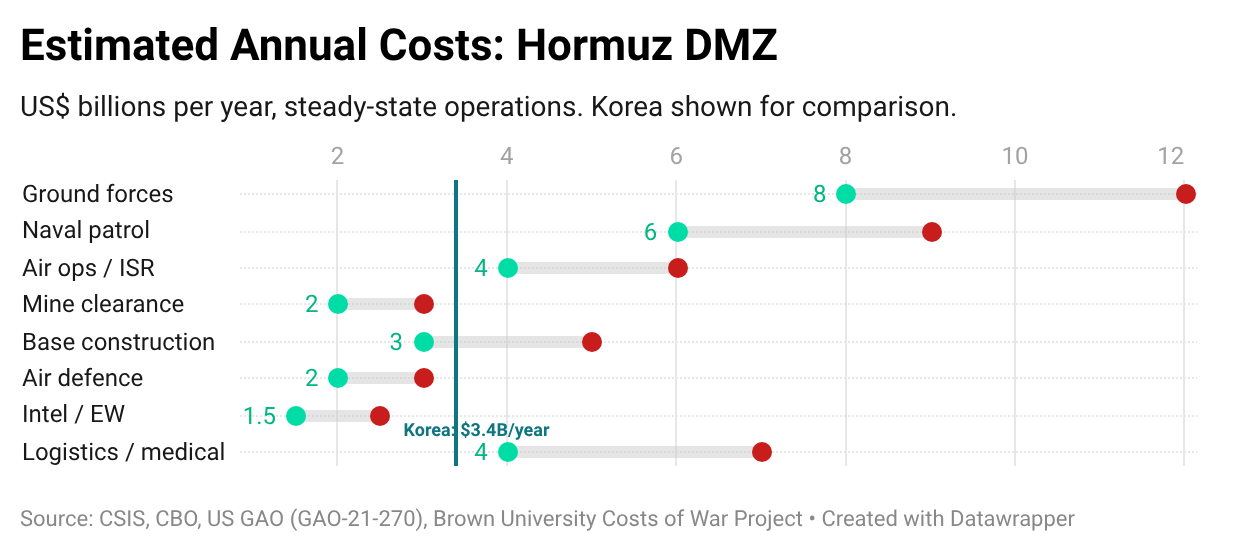
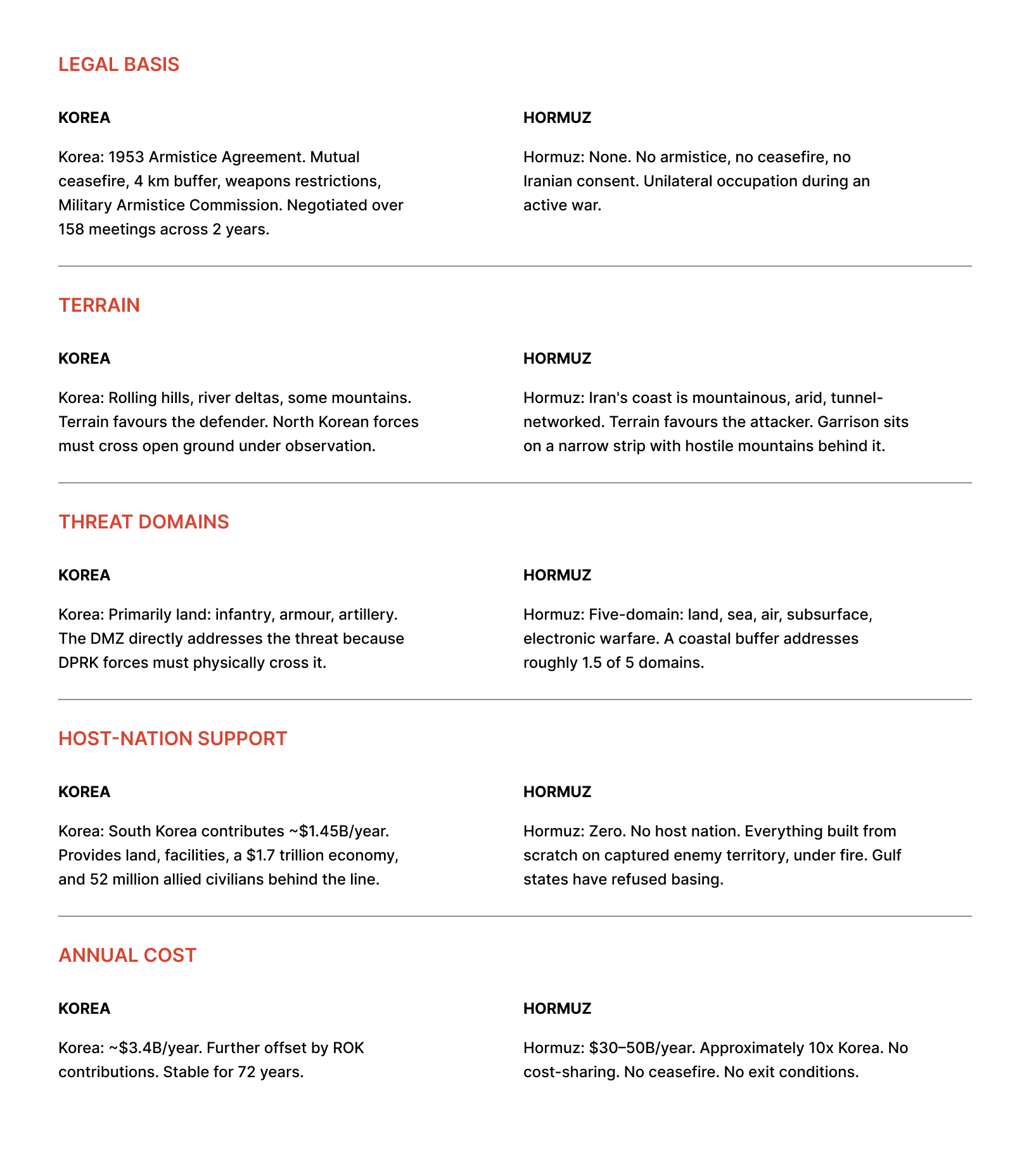
The Korea reference line tells the story. The entire US Forces Korea operation costs $3.4 billion per year. The Hormuz DMZ would cost roughly 10 times that, with no host-nation cost-sharing and no ceasefire.
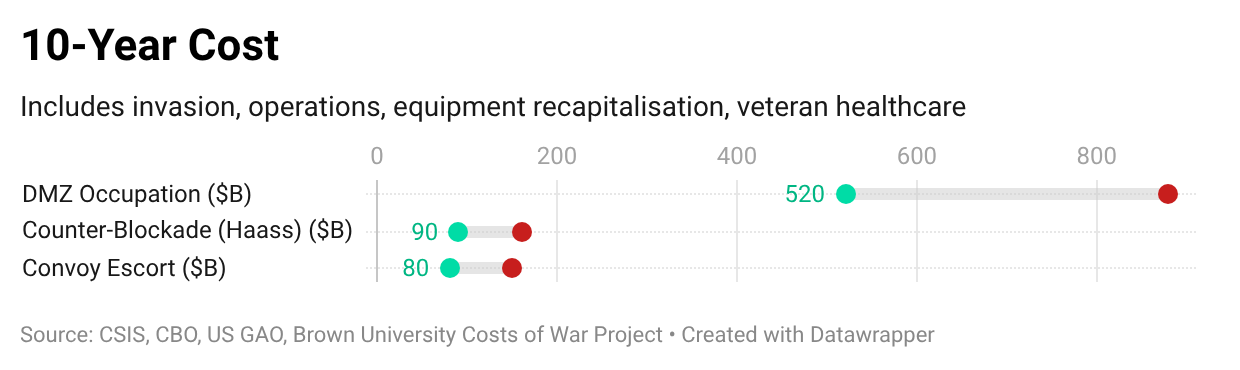
Over ten years: $520 to $880 billion. For comparison, the Iraq War cost approximately $2 trillion over two decades. The Hormuz DMZ would run at roughly 25 to 45 percent of that annual rate, indefinitely, with no exit strategy.
The Korea Analogy Doesn't Hold
The most common counterargument is: "We did it in Korea. We can do it here." The troop number is almost identical. The frontage is comparable. The comparison is intuitively appealing. It is also deeply misleading.
The Haass Alternative
On March 18, Richard Haass (former State Department Director of Policy Planning, former CFR President) published a proposal titled "The Strait of Hormuz: It Must Be Open for All or Closed to All." The logic inverts the problem. Instead of pushing commercial ships through a mined, missile-covered kill zone, you close the zone to Iranian commerce too. A naval interdiction line across the Gulf of Oman, roughly 320 km southeast of the strait, intercepts Iranian oil exports before they reach open water. Iran earned approximately $43 billion from oil exports in 2024. Over 90 percent went to China.
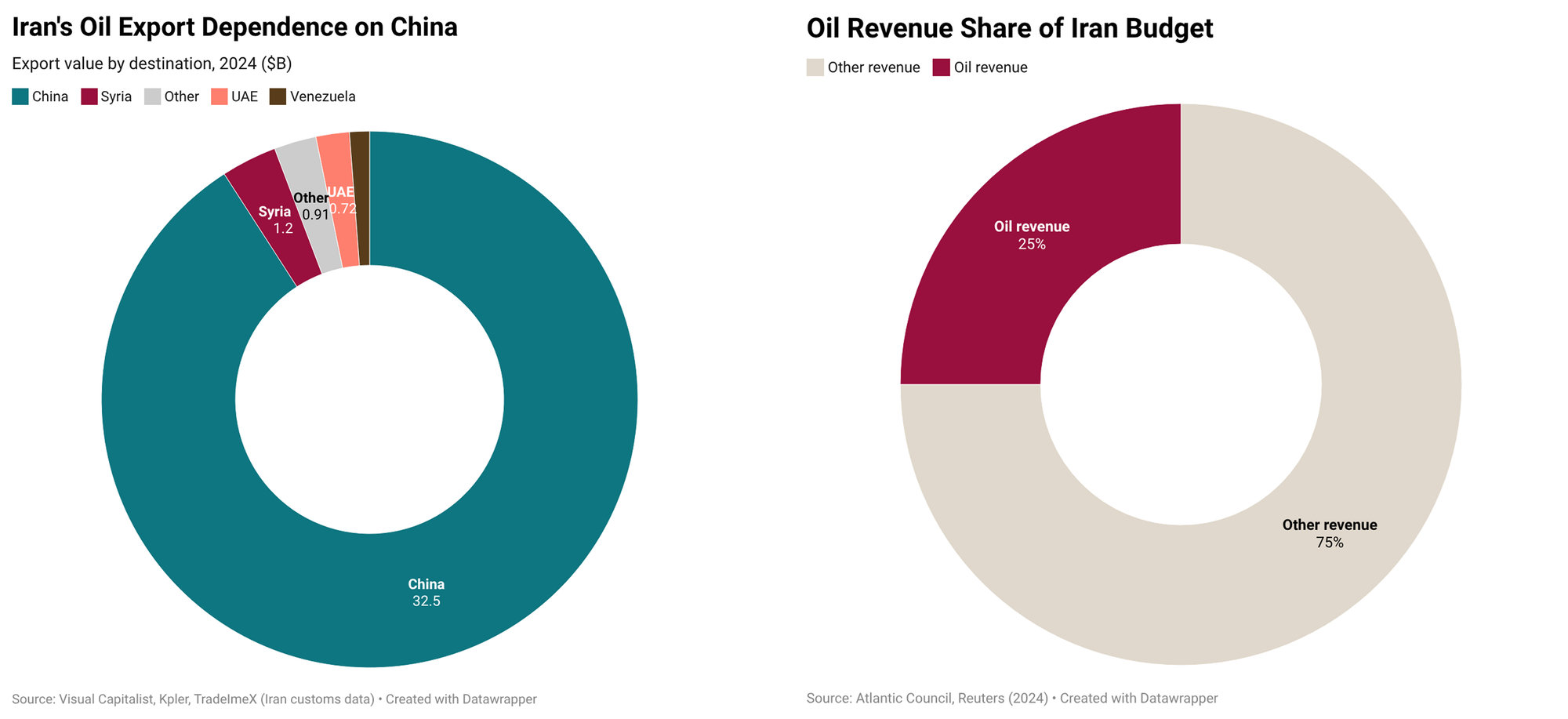
The counter-blockade costs $9 to $16 billion per year. Zero ground troops. It operates in open water, outside the mined strait, at roughly one-third the annual cost of the DMZ. Unlike the DMZ, it attacks Iran's economic centre of gravity. It is the only option that targets the funding mechanism for the missiles, the mines, and the speedboats, rather than the missiles, the mines, and the speedboats themselves.
Three Options Compared
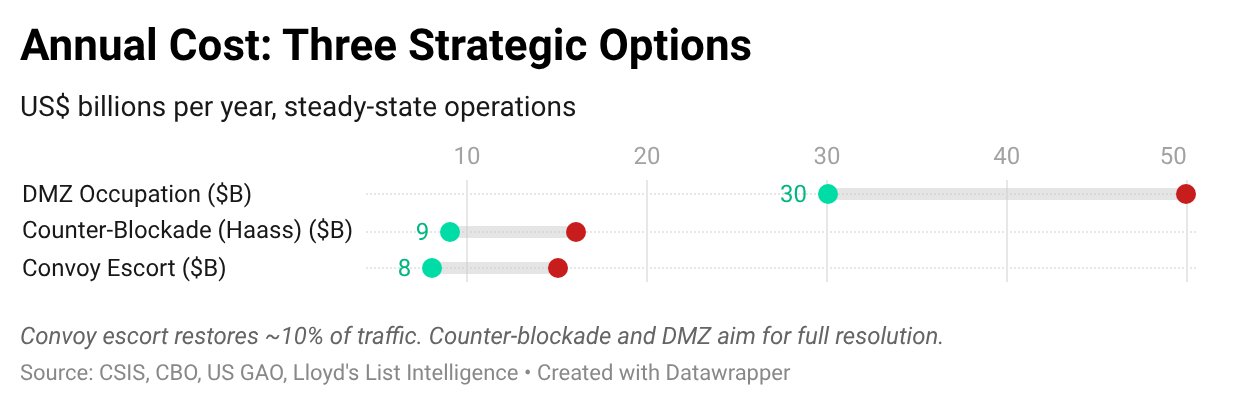

Option A: DMZ Occupation ($30–50B/year)
The option analysed in the preceding sections. Seize and hold 200 to 250 km of Iranian coastline plus five islands, garrison with 28,500 troops indefinitely. Addresses the fast-boat and short-range missile threat but does nothing about mobile launchers firing from 50 to 100 km inland, mines laid by fishing boats, or drones from deep in Iranian territory. Costs 10x Korea with none of the structural advantages that make Korea sustainable.
Option B: Convoy Escort ($8–15B/year)
The historical precedent is Operation Earnest Will (1987 to 1988), when the US reflagged Kuwaiti tankers and escorted them through the strait during the Iran-Iraq tanker war. The results were mixed at best. The first reflagged tanker, the Bridgeton, struck an Iranian mine on its very first transit. Iranian mine-laying outpaced US minesweeping for months. Lloyd's of London did not reduce Gulf war-risk premiums until several months of successful transits had been completed. A modern convoy escort operation would require 7 to 8 destroyers providing air cover, dedicated mine countermeasure vessels sweeping ahead of each convoy, and continuous ISR overhead. India and Pakistan have already sent destroyers to escort tankers in the Gulf of Oman, though not through the strait itself. The fundamental problem is throughput: you can escort 3 to 4 commercial ships per day, restoring roughly 10 percent of pre-crisis traffic. The insurance market remains spooked because ships are still transiting the kill zone. One successful mine strike on an escorted vessel resets the clock entirely. It is the weakest of the three options: the most reactive, the least decisive, and the most vulnerable to a single Iranian success.
Option C: Counter-Blockade ($9–16B/year)
The Haass proposal, detailed in Section VI. A naval interdiction line across the Gulf of Oman intercepts Iranian oil exports in open water, outside the mined strait, with zero ground troops. It is the only option that attacks Iran's economic centre of gravity rather than defending against its military periphery. The primary risk is Sino-American naval confrontation over interdicted Chinese-bound tankers. The primary advantage is strategic leverage: Iran cannot fund the missiles, mines, and speedboats if the revenue stream is cut.
Click below to read the full analysis: